Showing posts with label joseph smith. Show all posts

Friday, March 16, 2012

Richard Bushman on the Nature of God

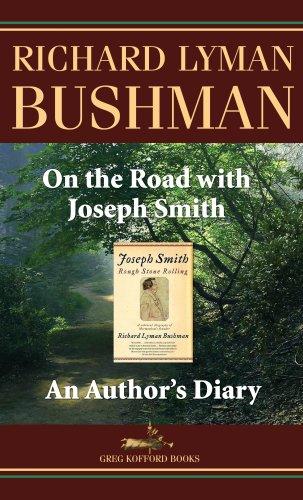
I have been reading Richard Bushman’s published diary On the Road with Joseph Smith. Bushman is the author of Joseph Smith: Rough Stone Rolling, a massive biography of the Mormon prophet. I have read the biography as well and loved it. In this author’s diary he writes of his experiences going to book signings and meeting with people around the country talking about his book and about Joseph Smith.

I found the following entry especially intriguing. He goes on a whole riff about the nature of God and all kinds of interesting stuff.

October 28, 2005

… My son Ben came to the signing after finishing his work in Draper where his small computer firm has an office. Afterward we had dinner at a nearby Chinese restaurant. He was curious about my answer to a question about any inspiration I had while writing the book. The questioner wanted to know if any doctrines had come to me strongly. I replied that some had, but I could not say much about them in that setting. Ben was intrigued by my mysterious evasion, and I told him that some doctrines I considered most valuable to my inner life were incommunicable. When I tried, they fell flat. Later in the discussion, he said he was working with the idea that God had optimized the world to the maximum benefit of all his children. I replied this implied he actually controlled everything, leaving us with no free agency. We went back and forth on this point rather unsatisfactorily. I could not make myself clear, underscoring my feeling about my favorite doctrines going nowhere when I try to describe them. My reservations go beyond my inability to describe them to my uncertainty about their validity. Am I demeaning God in not allowing him perfect control over all events and perfect knowledge of everything that will happen? What is my point of view?

1. God is one of a number of superior intelligences who have learned—how we do not know exactly—to obtain glory and intelligence. They can create worlds and do much else.

2. These gods take us lesser intelligences, swimming about like fish in the sea, under their tutelage, saying they will teach us how to achieve intelligence and glory.

3. One of their great lessons is that we can do more acting together than we can standing (or swimming) alone. Thus, they bind us to them with multiple covenants.

4. We are not only to obey them; we are to join with our brothers and sisters in the order of the priesthood under God’s direction. This priesthood goes back before the foundations of the earth and includes all the gods who have gone before. They are bound into one God whose combined force and intelligence is the source of glory. We may even add to the glory by joining them—like computers strung in parallel, generating computing power. Hence the essential importance of unity.

5. In this sense, the priesthood is God. When joined together like the council of gods that organized the earth, it manifests its godly powers. At the same time, any one God can speak for the whole because they are unified. Adam can become the God of this earth under Christ’s suzerainty.

6. We exist on the ragged edges of this holy order, but in subscribing to it we join the grand alliance that rules the godly universe.

7. Outside of this created order, only chaos reigns, but in the outer darkness are other intelligences such as Lucifer who have orders and priesthoods of their own, independent of and possibly in opposition to Elohim’s.

8. Within the created order, the intelligences find their places, some as animals, some as stones perhaps, some as humans. The diversity of forms on the earth suggests the diversity of unorganized intelligences. Hence the detail in the temple account of creation of the many forms of life, each to fulfill the measure of its creation.

9. Ben believes each of these intelligences will assuredly find its true place where it can maximize its possibility. God will guarantee that. He may be right but I suggest the alternative view that God is constantly recruiting intelligences to the godly path and the success of this operation depends on us. If we attract people to Christ, they get included; if someone doesn’t reach them, these souls may slip to a lesser spot. God will not necessarily guarantee everyone the highest possible position for his or her intelligence. Some may fall to a lower rung because there was no one there to raise them up. It is scary, but it makes life real. What makes it less scary is that there are many ways to grow in intelligence. The Mormons are not the only source of light. Christ radiates throughout the world, through many voices. We need only to listen to one to set our foot on the right path.

As I write, this doctrine tastes good to me. I believe it is truth. All of it can be found in Joseph’s teachings...

I have always found Joseph Smith’s ideas about eternal progression and exaltation very inspiring and expansive. I thought Bushman’s articulation of these concepts was interesting and worth sharing.


Note: The excerpt above is from pages 59-61.

Monday, March 15, 2010

The Council of Gods, Part 1

The religion of Ancient Israel has been called “monotheistic” which is understood to mean belief in one god and only one god. The Hebrew Bible, the Old Testament is filled with calls to give complete devotion to Yahweh and to none other. Consider the following passages:

“Is there a God beside me? yea, there is no God; I know not any.” (Isaiah 44:8)
“I am the LORD, and there is none else, there is no God beside me... there is none beside me. I am the LORD, and there is none else.” (Isaiah 45:6-7)
“I, even I, am the LORD; and beside me there is no saviour.” (Isaiah 43:11)

If there is one storyline that is told again and again in the Old Testament it is that Yahweh blesses Israel, Israel goes after other gods, Yahweh warns Israel through his prophets, Yahweh punishes Israel, Israel repents, and Yahweh blesses Israel, and the cycle continues. In the LDS church this kind of repeated behavior within a society is called the “Pride Cycle” and is also found in the Book of Mormon. How then can we explain this statement by Joseph Smith?

“I will preach on the plurality of Gods. I have selected this text for that express purpose. I wish to declare I have always and in all congregations when I have preached on the subject of Deity, it has been the plurality of Gods.” [1]

This statement is seemingly very radical and strange to modern Christian sentiments, not to mention to Jewish and Muslim sentiments. In Islam, monotheism is the foundational principle of the faith. It is called the Shahadah: “I bear witness that there is no god but al-Lah and that Muhammad is his Messenger.” Jews have a similar proclamation of faith called the Shema: “Hear, O Israel: the LORD our God is one LORD” (Deuteronomy 6:4). Christians have a bit more difficulty with monotheism because Jesus Christ is the Son of God and the Holy Ghost is understood to be God as well. What do we make of three Gods? The traditional solution is the Trinity as expressed in the Athansian Creed. Let me continue with the quote from Joseph Smith.

“I have always declared God to be a distinct personage, Jesus Christ a separate and distinct personage from God the Father, and the Holy Ghost was a distinct personage and a Spirit: and these three constitute three distinct personages and three Gods. If this is in accordance with the New Testament, lo and behold! we have three Gods anyhow, and they are plural; and who can contradict it?... the doctrine of a plurality of Gods is as prominent in the Bible as any other doctrine. It is all over the face of the Bible. It stands beyond the power of controversy. A wayfaring man, though a fool, need not err therein.” [1]

Joseph Smith makes a very good point here and it is often overlooked. When he called “Jesus Christ a separate and distinct personage from God the Father” he was in direct violation of the Athansian Creed which says “So are we forbidden by the Catholic Religion; to say, There are three Gods, or three Lords.” But though he may have been in violation of this creed he was on sure scriptural footing. I believe Joseph Smith was right to say that the plurality of Gods is “all over the face of the Bible”. However, an important point that he made and I shall make as well is this:

“Paul says there are Gods many and Lords many. I want to set it forth in a plain and simple manner; but to us there is but one God—that is pertaining to us; and he is in all and through all... I say there are Gods many and Lords many, but to us only one, and we are to be in subjection to that one, and no man can limit the bounds or the eternal existence of eternal time.” [1]

The New Testament has plenty to say about the Godhead but I would like to focus here on the Old Testament and the Council of Gods. One of the best treatments I have found on the Council of Gods in relation to Mormon doctrine is that of Blake Ostler in the third of volume of the series “Exploring Mormon Thought: Of God and Gods”. It is an excellent book that I would recommend to anyone interested in the subject. Ostler defines a term he calls “metaphysical monotheism”:

“There exists a simple, immaterial substance SS that: (i) is necessarily the sole of instance of the kind ‘divine’ and utterly unique in the sense that there are no other members in the class of being occupied by SS; (ii) alone has ontologically necessary actuality; and (iii) everything else that is actual in any way depends upon SS for its actuality.” [2]

Ostler proposes, however, that metaphysical monotheism is an anachronistic view of the Hebrew Bible and not the original understanding of the authors. While it is clear from the Bible that Yahweh is foremost and preeminent, the only God worthy of devotion—there are passages that suggest that he is not the only being of his kind, the only divine being.

One interesting passage is found in Psalms 82:

“Elohim takes his stand in the assembly of El, among the gods he pronounces judgement. How long will you judge unjustly and favor the cause of the wicked? Selah. Defend the lowly and fatherless; render justice to the afflicted and needy. Rescue the lowly and poor; deliver them from the hand of the wicked. They neither know nor understand, wandering about in darkness; all the world’s foundations shake. I have said, You are gods and all of you sons of Elyon, But you shall die like mankind, and fall like one of the princes. Arise, O Elohim, judge the earth: for yours are all nations.”

What is going on here? This psalm is best understood in the context of an ancient Israelite belief. After the Flood the descendants of the three sons of Noah spread abroad across the earth and became many nations, seventy to be exact. Seventy names are listed in Genesis chapter 10 and 11. These chapters constitute a “Table of Nations”. This organization of nations was later referenced in Deuteronomy:

“Remember the days of old, consider the years of many generations: ask your father, and he will tell you; your elders, and they will tell you. When the Most High divided to the nations their inheritance, when he separated the sons of Adam, he set the bounds of the people according to the number of the children of Israel. For the Yahweh’s portion is his people; Jacob is the lot of his inheritance.” (Deuteronomy 32:8-9)

The passage above is a translation from the Masoretic text which date from between the seventh and tenth centuries of the Common Era. An older version, however, is found in the Dead Sea Scrolls which dates back to 200 BCE:

“When the Most High gave to the nations their inheritance, when he separated humanity, he fixed the boundaries of the peoples according to the number of divine beings. For Yahweh’s portion is his people, Jacob his allotted heritage.” (4QDeut 32:8-9)

The Hebrew phrase for “divine beings” in the Dead Sea Scrolls is “bene ‘elohim” which means “sons of God”. It is the opinion of many scholars that the Masoretic version of this passage was a product of some alteration that occurred in the interim—evidently in an effort to remove any inference that there were other divine beings along with Yahweh. But the message seems quite clear—this was an ancient belief. If the Israelite children were to ask their fathers or elders they could tell them the story. When the nations were divided up Yahweh was given charge of Israel.

But what happens in Psalms 82? All the other gods given charge of the other nations have not been doing their job. They have not taken care of the poor, the orphans. They have not exacted justice. So Elohim takes charge of all the nations of the earth. The other gods are sent down to earth to live and die as mortals and Elohim takes charge of all. “Arise, O Elohim, judge the earth: for yours are all nations.”

What is seen here is exactly what Joseph Smith had taught—there may be many gods, many divine beings but one is superior to them all. So was the understanding in ancient Israel. Among the gods there was but one who was worthy of worship and that is Yahweh. But what is the role of the other gods? What does the Council of Gods do? More on that for subsequent posts.

References

[1] Smith, Joseph Fielding. Teachings of the Prophet Joseph Smith. Covenant Books. 2002. p. 383-84.

[2] Ostler, Blake. Exploring Mormon Thought: Of God and Gods. Kofford Books. 2008. p. 42.

Thursday, February 11, 2010

The Body: Sacred Or Profane?

One of the early Christian sects, the Gnostics, believed that the human body was evil. They even saw the human body as a prison for the soul and that salvation consisted, in part, of escaping the confines of this mortal shell. The pleasures of mortality were especially reprehensible and those who indulged in the pleasures of this world could find their souls continually imprisoned even after death, never to return to God. The Gnostics were not alone in their negative views of the human body, nor are these ideas confined to ancient times. It is quite common today for people to have negative views of the body and these sentiments are not exclusively from religion. The Buddhist concept of the body doesn’t malign the body per se but sees the escape from samsara, the cycle of birth and rebirth, as the ultimate goal. This escape is Nirvana. In the Pali language “Nibbana” means “blowing out”, that is to say a blowing out of the fires of greed and hatred. Here also, is the ultimate goal of escape from the body.

In the Bible and in Christian discourse, the flesh, the body is sometimes synonymous with corruption. Here are some examples:

“With the mind I myself serve the law of God; but with the flesh the law of sin.” (Romans 7:25)

“That the righteousness of the law might be fulfilled in us, who walk not after the flesh, but after the Spirit. For they that are after the flesh do mind the things of the flesh; but they that are after the Spirit the things of the Spirit.” (Romans 8:4-5)

“So then they that are in the flesh cannot please God” (Romans 8:8)

“Now this I say, brethren, that flesh and blood cannot inherit the kingdom of God; neither doth corruption inherit incorruption.” (1 Corinthians 15:50)

It can be seen from these scriptures why Christians have developed a negative view of the body, or “the flesh”. But is the body really what is corrupt? What are we to do with the body? How should we view it?

Joseph Smith taught a very different doctrine about the body. He said: “We came to this earth that we might have a body and present it pure before God in the celestial kingdom. The great principle of happiness consists in having a body. The devil has no body, and herein is his punishment.” [1] Historian and biographer Richard Bushman said: “Joseph had little sense of the flesh being base. In contrast to conventional theologies, Joseph saw embodiment as a glorious aspect of human existence.” [2] Furthermore, Joseph Smith understood the salvation of the soul to consist of saving both the spirit and the body. “The perfection Joseph sought was physical as much as spiritual. The September priesthood revelation [Doctrine and Covenants 84] had said priesthood holders would be “sanctified by the Spirit unto the renewing of their bodies... The underlying idea of the ‘Word of Wisdom’ was not to escape the physical, as hermetic and mystical philosophies taught, but to preserve and purify the flesh. Joseph’s religion made the body essential to human fulfillment and godliness. The exaltation revelations had told the Saints that ‘the spirit and the body is the soul of man,’ and only when joined eternally could a person receive ‘a fulness of joy.’ ‘When separated, man c[a]nnot receive a fulness of joy.” Joseph exalted the body rather than seeking to free the spirit from the flesh. Dead souls considered ‘the long absence’ of their spirits from their bodies ‘to be a bondage.’ The highest reward for a worthy spirit, the ‘Olive Leaf’ [Doctrine and Covenants 88] had said, was to receive a ‘natural body.’ [3]

Joseph not only taught that the body is something good and holy but he also taught that God the Father has a body. “That which is without body, parts and passions is nothing. There is no other God in heaven but that God who has flesh and bones (John 5:26). As the Father hath life in himself, even so hath he given to the Son to have life in himself. God the Father took life unto himself precisely as Jesus did.” [1] Later, in the now-canonized Doctrine and Covenants verse he taught: “The Father has a body of flesh and bones as tangible as man's; the Son also; but the Holy Ghost has not a body of flesh and bones, but is a personage of Spirit. Were it not so, the Holy Ghost could not dwell in us.” (Doctrine and Covenants 130:22)

On August 8, 1901 B.H. Roberts delivered a lecture before the conference of the Mutual Improvement Associations of the Salt Lake Stake of Zion. The title of his lecture was “The ‘Mormon’ Doctrine of Deity. In his lecture he stated:

“I take it that we may classify under three heads the complaints here made against us with reference to the doctrine of Deity.

“First, we believe that God is a being with a body in form like man’s; that he possesses body, parts and passions; that in a word, God is an exalted, perfected man.

“Second, we believe in a plurality of Gods.

“Third, we believe that somewhere and some time in the ages to come, through development, through enlargement, through purification until perfection is attained, man at last, may become like God—a God.” [4]

A reply was published in the Improvement Era by Reverend C. Van der Donckt, of the Catholic Church, Pocatello, Idaho. In his response, Van der Donckt presented an extensive treatment of each of the points Roberts had taught in his lecture. Van der Donckt challenged Roberts in both scripture and philosophy. His philosophical arguments against God’s corporeality were particularly intriguing.

“The ‘Mormons’ admit that God existed from all eternity; consequently, there was no time at which God did not exist. Therefore, the Eternal Being, or God, must be simple.

“A compound is, at least by nature, posterior to its component parts. If God is a compound, he is posterior to his component parts. Therefore, he would not be eternal; therefore, not God...

“Fancy a clock, an engine, a shoe, or any composite being. The parts must exist before the whole. Then to have the compound, some one or something must do the compounding, or put the ingredients or elements together. Who then did compound the Eternal?” [5]

“Several finite things cannot produce an infinite or an illimitable, as there would always be a first and a last... If one is infinite, nothing can be added to it. Finite parts could not belong to the infinite essence, else they would communicate limitations to God. Therefore, the Infinite Being is not composite, but simple or spiritual. Therefore, he is not, nor ever was, a man, who is a composite being.” [6]

To put what Van der Donckt is saying another way—if God has a body, that body is composed of many parts. For example, the human body contains approximately 50 trillion cells—it is far from simple. Even the individual cells of the body are complex constructions of many atoms into biomolecules of high molecular weight. If God’s body is similarly formed of multiple parts how can he be eternal or infinite, being himself preceded by the elements of which he is composed?

Roberts responded as follows:

“Mr. Van der Donckt himself says: 'Something is limited not because it is (i.e. exists): but because it is this or that; for instance, a stone, a plant, a man'—or a person, I suggest. For if God has personality, he is a person, a something, and hence limited,.. as he must be when conceived of as this or that, as a person for instance, then of course not infinite being; and thus my friend’s doctrine of God’s 'simplicity' is destroyed the moment he ascribes personality to Deity.” [7]

Roberts’ point here seems to be that if you ascribe any characteristic or description about God then you limit him as an infinite being. Roberts did not have much of a problem with this because he did not consider Mormon doctrine to be bound to the creedal assumption that God should be infinite or simple.

“But we have already seen that God cannot be considered as absolutely infinite, because we are taught by the facts of revelation that absolute infinity cannot hold as to God; as a person, God has limitations, and that which has limitations is not absolutely infinite. If God is conceived as absolutely infinite, in his substance as in his attributes, then all idea of personality respecting him must be given up; for personality implies limitations.” [8]

There seems to me a striking bend toward materialism in both the theologies of Roberts and Joseph Smith. Joseph Smith himself said: “There is no such thing as immaterial matter. All spirit is matter, but it is more fine or pure, and can only be discerned by purer eyes; we cannot see it; but when our bodies are purified we shall see that it is all matter.” (Doctrine and Covenants 131:7-8) This is a surprising idea for a religion since religions are often tasked with the realm of the “supernatural”. Joseph Smith says essentially that there is no such thing as supernatural, only natural. Granted, spirit matter must be different from most matter we are familiar with since “we cannot see it”. But if all spirit is matter than we can safely surmise that it behaves in a somewhat similar way.

If God has a physical body, it should be composed of many parts, cells perhaps. Of course, resurrected bodies must be quite different from our mortal bodies. For one thing, a resurrected body does not die. Joseph Smith also taught “all [men] will be raised by the power of God, having spirit in their bodies, and not blood.” [9] So resurrected bodies have flesh and bone instead of flesh and blood. If this is meant literally, then it means that the body of God is very different. Blood is mostly water in which nutrients, proteins, and substrates are delivered to our cells. This means that resurrected bodies may not even be water-based, while our bodies are mostly water. But putting these differences aside, I find the idea that my body is at least in the image of God’s quite appealing. The human body is a masterpiece. It is not simple—it is composed of many parts. But as Carl Sagan said, “the beauty of a living thing is not the atoms that go into it but the way those atoms are put together.”

The idea that God the Father is embodied and that we resemble him is not trivial. It affects the way we view God and relate to him. B.H. Roberts’ key point in proving the corporeality of God was in the humanity of Jesus Christ. Jesus was a god and he had a body. As odd as it may sound, Jesus has sometimes been troublesome to Christian theology. This is because traditional Christianity has tried to reconcile the Hebrew religion in which Jesus ministered with Greek philosophy, specifically Neoplatonism. Philosopher Blake Ostler said:

“The complex of absolutist properties derived from both Middle Platonism and Neoplatonism—immutability, simplicity, timelessness, impassibility and incorporeality—was accepted as axiomatic properties of divinity even though not a single one of these terms appeared in the Judeo-Christian writings and seemed to positively contradict much of what was found therein... The notion that God became a man in Jesus of Nazareth and saved the world by suffering with, because of and on behalf of the world was difficult to reconcile with the Neoplatonic notion of God which maintained that God was absolutely unaffected by anything that happened in the world. How could such a view be squared with the belief that Jesus of Nazareth was in fact very God? Everything the Neoplatonists meant by the word God was contradicted if Jesus was somehow a revelation of the divine nature—God was thought of as immaterial and incorporeal and yet Jesus had a material body. God did not change and yet Jesus clearly grew and changed over time. God could not suffer in any way and yet Jesus suffered.” [10]

Particularly troubling was the idea that God had a body: “For Greeks, it was unthinkable that the divine be corporeal (i.e., have a physical body). It was even more unacceptable to assert that a divine being could suffer, for the divine was simple or noncomposite and above the change and the obvious decay of order accompanying anything that could suffer.” [11] Yet while these images of Jesus did not fit into the Greek paradigm, there were still the images portrayed in the scriptures.

My view of the body is very positive. I believe that the human body is a reflection of the divine image of God. The body is not something to be despised but something to be revered and reverenced. We should take care of our bodies and appreciate them. We have the gifts of senses and sensations, joys and pleasures that come with a body and we should be grateful for them. For me, the knowledge that Jesus was both God and man is encouraging. I have something to look to and aspire to. I know the way to God because Jesus said “he that hath seen me hath seen the Father”. (John 14:9) From this I understand that the Father is a person. He is not supernatural but he is natural. He is not an ethereal vapor, or dream—that is the same as nothing. God is matter as we are matter. And we can evolve in our inborn potential to be as our Father.

References

[1] Teachings of the Prophet Joseph Smith. Covenant Communications. 2002. p. 185

[2] Bushman, Richard Lyman. Joseph Smith: Rough Stone Rolling. Vintage Books. 2005. p. 420-21

[3] Ibid. p. 212-13

[4] Roberts, B.H. The Mormon Doctrine of Deity: The Roberts-Van Der Donckt Discussion. Signature Books. 1998. p. 11

[5] Ibid. p. 51

[6] Ibid p. 53-54

[7] Ibid. p. 111

[8] Ibid. p. 126

[9] History of the Church 4:555-56

[10] Ostler, Blake. Exploring Mormon Thought: The Attributes of God. Kofford Books. 2001. p. 30

[11] Ibid. p. 421

Sunday, February 7, 2010

Search For God


“Look up. Aspire. Push back your horizons. Seek for the answers. Search for God.”
-Hugh B. Brown [1]

Who is God? The question itself, asked in this manner, presupposes the idea of a divine personality. There are many ideas and beliefs concerning this very point, some of which would say that asking “who” God is would not be that right question in the first place. Still others would suggest that asking any question at all about God is meaningless because God is incomprehensible or even ineffable. This is not a question to be trifled with nor is it question with an easy answer. Were it easy it would not weigh so heavily on the minds of so many people.

Jesus gave the matter special importance: “And this is life eternal, that they might know thee the only true God, and Jesus Christ, whom thou hast sent” (John 17:3). Thus, knowing God, the only true God, and Jesus Christ is the quest of life, life eternal. Joseph Smith said: “Let us here observe, that three things are necessary in order that any rational and intelligent being may exercise faith in God unto life and salvation. First, the idea that he actually exists. Secondly, a correct idea of his character, perfections, and attributes. Thirdly, an actual knowledge that the course of life which he is pursuing is according to his will. For without an acquaintance with these three important facts, the faith of every rational being must be imperfect and unproductive; but with this understanding it can become perfect and fruitful, abounding in righteousness, unto the praise and glory of God the Father, and the Lord Jesus Christ.” [2]

He said later in the King Follett Discourse: “There are but a very few beings in the world who understand rightly the character of God... If a man learns nothing more than to eat, drink and sleep, and does not comprehend any of the designs of God, the beast comprehends the same things. It eats, drinks, sleeps, and knows nothing more about God; yet it knows as much as we, unless we are able to comprehend by the inspiration of Almighty God. If men do not comprehend the character of God, they do not comprehend themselves. I want to go back to the beginning, and so lift your minds into a more lofty sphere and a more exalted understanding that what the human mind generally aspires to.” [3] This quest for exalted understanding makes all the difference. It is not only to understand some fantastic being off light-years away from here or who-know where. The journey to comprehend God is a journey of self-discovery “for in him we live, and move, and have our being... for we are also his offspring” (Acts 17:28).

What is this kind of knowledge worth? To the King Lamoni and his father it was worth a great deal. When Aaron came to him he did not know anything about God. He had permitted the Amalekites to build sanctuaries to worship but did not even have a belief in God himself. Aaron taught him to pray and to speak with God. King Lamoni prayed: “O God, Aaron hath told me that there is a God; and if there is a God, and if thou art God, wilt thou make thyself known unto me, and I will give away all my sins to know thee, and that I may be raised from the dead, and be saved at the last day” (Alma 22:18). Lamoni was willing to give up all his sins. This is significant. This was a life-changing moment. This was the turning, his teshuvah or repentance. He was willing to put away everything that kept him from God.

We ultimately rely on God to reveal himself but we must seek after him. This is not only a theological exercise. It is a relationship that we build, a relationship of unity, the transformation of our character into the likeness of Christ, the image of God on earth. It is ultimately through the revelations and God that we are able to find him. “Behold, great and marvelous are the works of the Lord. How unsearchable are the depths of the mysteries of him; and it is impossible that man should find out all his ways. And no man knoweth of his ways save it be revealed unto him; wherefore, brethren, despise not the revelations of God.” (Jacob 4:8)

References

[1] Brown, Hugh B. Continuing the Quest. Deseret Book Company. 1961. p. 252
[2] Lectures on Faith. Bookcraft. p. 41
[3] Teachings of the Prophet Joseph Smith. Covenant Communications. 2002. p. 355

Wednesday, December 30, 2009

Bereshith - The Creation


In the beginning of the year I am beginning again, again. I last read the Old Testament cover-to-cover on my mission. I was inspired to this by one of my missionary companions. He actually read the entire Old Testament while sitting on a toilet. Now that was not all in one sitting but I still found that quite impressive. However, I don’t think I will be doing that for this read-through. One reason I want to write about my readings as I go through is that I hope it helps me to learn more and to record the things I learn. I can also get into discussion with people online and have stimulating conversation. The problem now is that the first chapters of the Bible are the most difficult to get through. This is not because I find them boring but because I find them so interesting. There is so much in these verses and there is a lot of history in their interpretation. So I may not get very far in this first post. I want to start by looking at the first three words of the Hebrew Bible.

“Bereshith bara elohim...” are the first three words of the Tanakh, or Hebrew Bible. The name of the Book of Genesis in Hebrew is also “Bereshith”. These three words are usually translated “In the beginning created God...” sometimes with the word order switched around. I’d like to talk a little about each word individually.

“Bereshith” is really a combination of two concepts. “Be” is a preposition meaning “in” or “with”. “Reshith” means “the first” in place, time, order, or rank. By the way, all my definitions here are from Strong’s Hebrew Dictionary. The first word in the Bible, “bereshith” is understood to mean the first in time, as to say the beginning of time. This in itself is an interesting topic that deserves it own post. What happened before this beginning? What was God doing before the creation? Saint Augustine reportedly said “He was preparing hell for people who ask questions too deep for them.” A viable possibility to be sure, but perhaps the risk isn’t so great to prevent pressing the issue a little. I will come back to “bereshith” because the next two words reflect back on it.

The next word “bara” is a verb, meaning in the absolute sense, “to create”. The same verb also means “to cut down (a wood)”, “select”, and “feed (as formative processes)”. Blake Ostler, in his book Exploring Mormon Thought: Of God and Gods, gave an exhaustive overview of this words which I refer to here. The other uses of the verb refer to cutting, dividing, and separating. The verb “bara” is often understood to be more of an organizing process as opposed to an instant materialization with a snap of the fingers. This is a view in opposition to creatio ex nihilo, or “creation out of nothing”. Again, this topic deserves its own post. But I would call attention to the interpretation of “bara” as an organization or bringing together.

The third word of the Bible, “elohim” literally means “gods”. The singular word for a god or deity is “eloah”. The plural “elohim” can be used to refer to multiple deities at a time or to refer to the supreme God. This word is often understood to simply be referring to the God in a superlative form in a form of deference. Yet later in the chapter elohim speaks in the first person plural. Verse 26 says “And said, elohim, let us make man in our image, after our likeness.” After both words, image and likeness, the nouns our followed by the possessive suffix “enu” which is the first person plural pronoun suffix meaning “our”. This seems to suggest that the elohim speaking is more than one deity. In fact, modern biblical scholarship often suggests that the prevailing understanding of divinity in Ancient Mesopotamia was not of one and only one god but a heavenly council of many deities over which one god, the most high God presided. But this is also a topic for another post.

Joseph Smith had an interesting interpretation of the Bible’s first word. Never shirking his role as an iconoclast, he claimed that the very first word of the Bible was not correct. The following quote is taken from a transcription of Joseph Smith’s Sermon in The Grove, given June 16, 1844, one week before his death.
Some say I do not interpret the Scripture the same as they do. They say it means the heathen's gods. Paul says there are Gods many and Lords many; and that makes a plurality of Gods, in spite of the whims of all men. Without a revelation, I am no going to give them the knowledge of the God of heaven. You know and I testify that Paul had no allusion to the heathen gods. I have it from God, and get over it if you can. I have a witness of the Holy Ghost, and a testimony that Paul had no allusion to the heathen gods in the text. I will show from the Hebrew Bible that I am correct, and the first word shows a plurality of Gods; and I want the apostates and learned men to come here and prove to the contrary, if they can. An unlearned boy must give you a little Hebrew. Berosheit baurau Eloheim ait aushamayeen vehau auraits, rendered by King James' translators, "In the beginning God created the heaven and the earth." I want to analyze the word Berosheit. Rosh, the head; Sheit, a grammatical termination; the Baith was not originally put there when the inspired man wrote it, but it has been since added by an old Jew. Baurau signifies to bring forth;Eloheim is from the word Eloi, God, in the singular number; and by adding the word heim, it renders it Gods. It read first, "In the beginning the head of the Gods brought forth the Gods," or, as other have translated it, "The head of the Gods called the Gods together." I want to show a little learning as well as other fools.

I like this quote at least partially for Joseph Smith’s attitude. I think it’s kind of funny. But he brings up some interesting ideas. The spelling in the transliteration is different here so I’ll review the point of interest. Basically, he says that the preposition “be” does not belong in the text and that the first word in the Bible should be simply “reshith”. As noted earlier, “reshith” means “the first” in place, time, order, or rank. It is almost always understood to mean the first in time. But Joseph Smith understands it to mean the first in rank. In effect, the word “reshith” is identifying the God of gods. He is also correct that “reshith” shares the same root as “rosh” which means “the head” whether literally or figuratively. You might recognize this word when combined with another Hebrew word. The Hebrew word for year is “shanah”. So the New Year is the head of the year or “rosh hashanah”.

But Joseph Smith also understands the next word differently. Rather than referring to the creation of the universe itself, Joseph Smith sees the word “bara” referring to the calling forth or organization of divine beings, the elohim. Thus the third word is also understood differently. In Joseph Smith’s view the word “elohim” is not referring to the highest God himself at all but is referring to the other deity whom he is assembling to prepare for the creation.

Taken together, Joseph Smith taught that the first words of the Bible should be “reshith bara elohim.” His interpretation is essentially: “the head organized the gods”. Put another way: “the Head One of the Gods brought forth the gods.” This is basically the way the Book of Abraham lays out the Creation.

So there is a little review of my reading of the first three words of the Old Testament. Let’s see how far I get as I move on. I have touched on some topics that our too juicy to pass up. I definitely need to come back to the Council of the Gods. There are many references in the Bible itself, as well as ancient Ugaritic and Babylonian texts. But I’ll get to all that later.